Skip to content

#1 for true-positive rate, NIST Child Online Safety, ages 13-16See the evidence

#1 NIST true-positive rate, ages 13-16

Research

Research, with the evidence labelled.

What we have measured, who measured it and under what conditions. Independent results, our own evaluations and simulations are kept apart.

Different evidence deserves different weight.

A result measured by NIST is not the same kind of evidence as a benchmark we ran ourselves, and neither is the same as a mission flown in simulation. Each result below carries its type, its source and its date, so you can weigh it for what it is.

How to read the evidence

Results

Independent evaluation

Measured by an independent organization under its own protocol.

1 result

72.53%

True-positive rate, ages 13–16

#1 for true-positive rate in NIST's Child Online Safety evaluation for ages 13–16.

Bynn's facial age-estimation model, which powers Agemin, achieved a 72.53% true-positive rate: the proportion of people aged 13 to 16 correctly estimated within that age band.

  • Measured by NIST in its ongoing evaluation program. NIST evaluation is not certification or endorsement.
  • The result measures age estimation within the 13 to 16 band. It does not measure a reduction in online harm.
NIST FATE Age Estimation & Verification. Submission bynn-000.

View the NIST results

Bynn preliminary evaluation

Run by Bynn, published with its method and labelled preliminary.

2 results

81.6%

Mean accuracy, 15 text suites

81.6% mean accuracy across 15 text suites in Bynn's preliminary October 2026 evaluation.

DecisionNode MoE's result in Bynn's preliminary October 2026 evaluation. The suites contain 25,134 items and cover a range of decision tasks. The published comparison includes results where other models lead.

  • Bynn's own preliminary evaluation, run on development splits. Not an independent result.
  • A mean across suites, not a guarantee of accuracy on any single task.

19 ms

End to end, one short decision

In Bynn's preliminary measurement, DecisionNode Flash returned a short decision in 19 ms end to end.

Measured from one client with the network included. About 5 ms of that time was spent on the server.

  • One short decision on the Flash model, measured from a single client.
  • Bynn's own preliminary measurement. Not a latency guarantee for other inputs, models or networks.

DecisionNode benchmarks. Preliminary results, October 2026.

See how it was measured

Simulation

Demonstrated in a simulated environment, not in the physical world.

1 result

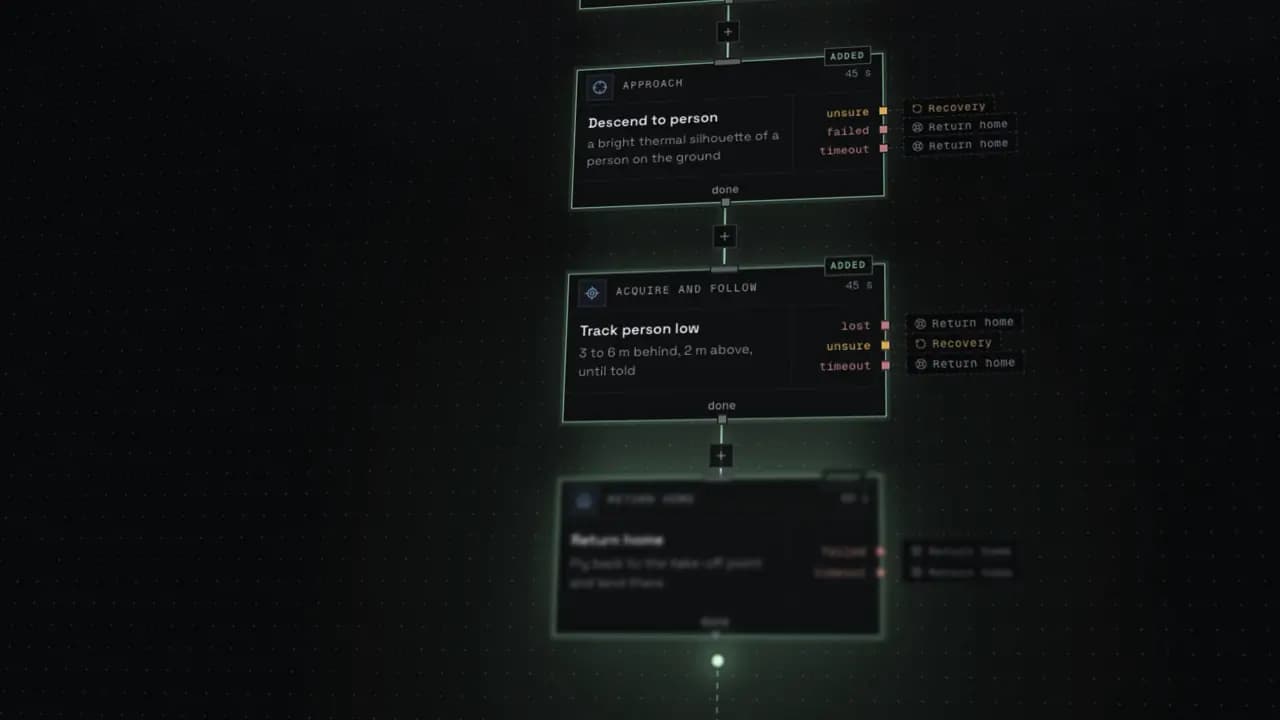
Zora in simulation: the mission editor's search-and-track graph, then Mission Control following a simulated flight.

Zora Air flies autonomous missions in simulation.

Missions are composed in Mission Control and, once started, flown by the autonomy engine without handing control back: take-off, observation, obstacle traversal and landing. DecisionNode answers the tactical questions about each camera frame; Zora plans the motion, checks every move and recovers from setbacks.

  • Simulation only. Physical vehicles and onboard computers are not yet implemented.
  • Zora is an experimental research platform, not a product on sale.

Zora project documentation, Bynn Intelligence.

Published by the portfolio entry

A figure a portfolio entry publishes about itself, such as a catalogue count.

1 result

43

Published catalogue entries

43 specialist models in the published Detector24 catalogue.

27 image models, 6 video, 3 audio and 7 text, from AI-generated image detection and document tampering detection to voice deepfake and fraud text detection.

  • The count of entries Detector24 publishes in its catalogue. It is not an independent validation of each model.

Discuss our research.

For partners and investors who want to go deeper than this page, we are glad to walk through the work and its evidence.

Book a meeting