Skip to content

#1 for true-positive rate, NIST Child Online Safety, ages 13-16See the evidence

#1 NIST true-positive rate, ages 13-16

DecisionNodeIntelligence that makes decisions.

Area
Decision intelligence
Status
Available

Evaluation

81.6%

Mean accuracy across 15 text suites, Bynn's preliminary October 2026 evaluation.

From $0.035 per 1M input tokens, output freeDecisionNode pricing

The part of the process that decides what happens next.

DecisionNode interprets text, images and structured inputs, then returns decisions that connected systems can act on, in workflows, applications and robotics.

Takes in
Text, images and structured data, with the question to answer
Returns
Typed decisions with confidence, for a system to act on

AvailableRuns as an inference service.

Talk to the DecisionNode team
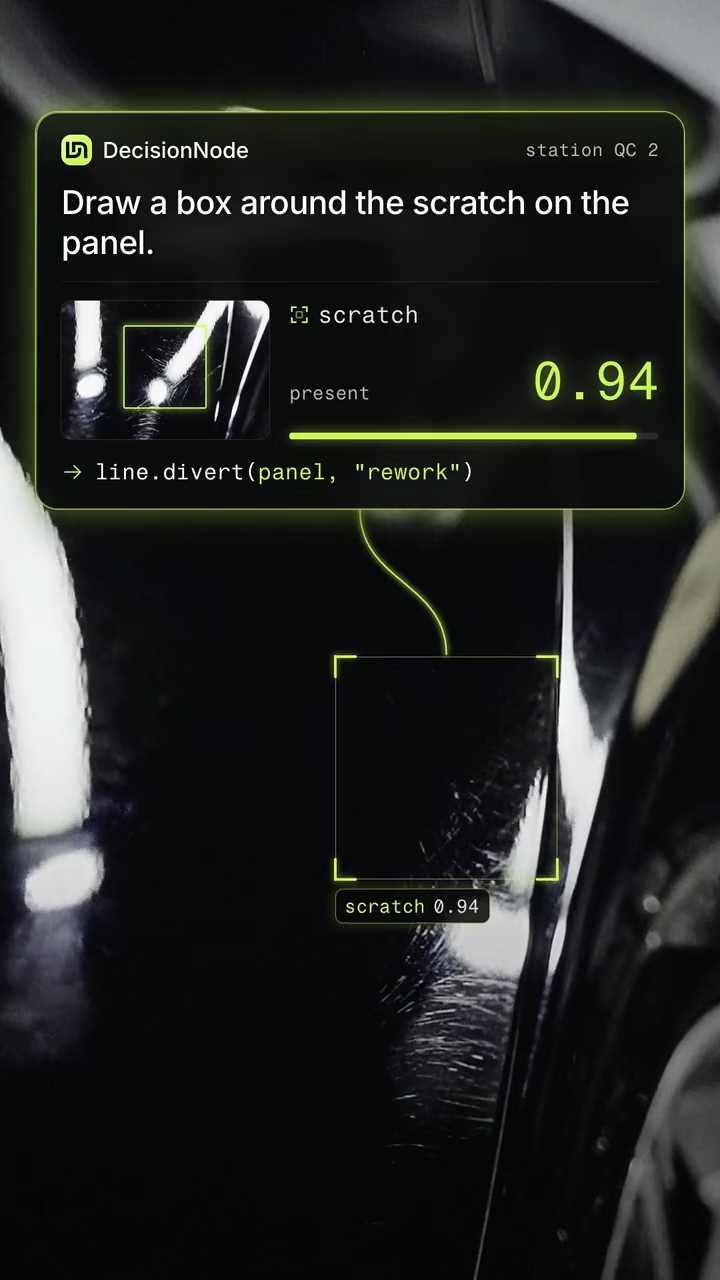
DecisionNode typed decisions for a survey drone on line inspection: continue at 0.87, abort false.

How it works

Inputs in. A typed decision out.

DecisionNode answers in the shape the workflow asked for, with a confidence value the system uses to decide whether to act or ask for review.

01In

A question and its evidence

New ticket, webhook

“Charged twice and no reply yet.”

  • Where should this ticket go?
  • Should it refund?
  • The ticket text from the webhook
  • The questions the workflow asks
  • Boosters, when a decision needs them

02DecisionNode

DecisionNode
  1. Add evidence

    Boosters can add specialist readings, such as an age estimate or OCR.

  2. Decide

    DecisionNode Flash or MoE interprets the inputs and answers each question.

  3. Act or review

    Above the threshold the system acts; below it, the case goes to review.

03Out

Typed answers with confidence

billing
0.87
bug
0.08
account
0.05
refund
true, 0.94
confidence
0.81

Result

Above 0.70, so it acts: billing, refund sent

Example values from the DecisionNode Flash support example shown on this page.

Decisions inside a workflow.

Where typed decisions do the work: an agent that runs a document workflow, and one that reasons over evidence to find fraud.

An AI agent requests documents in four languages, checks what comes back, sends the one it is unsure about to human review and moves the workflow on.

What DecisionNode provides

  • Two model tiers

    DecisionNode MoE for harder decisions and DecisionNode Flash for short decisions where response time matters most.

  • Typed decisions

    Answers come back in the shape the workflow asked for, with a confidence value the system can use to decide whether to act or ask for review.

  • Boosters

    Specialist models that add evidence to a decision: Human Age from Agemin, AI-generated image detection from Trinity, face detection and recognition, OCR, Depth Vision and Segment Vision.

  • Sessions

    Context that persists across a stream of inputs, such as camera frames from a moving system or steps in a long workflow.

  • Inference API

    Decisions served over an API, so an existing application can call DecisionNode at the point where it needs an answer.

Preliminary evaluation, run by Bynn

Bynn preliminary evaluation

81.6%Mean accuracy, 15 text suites

81.6% mean accuracy across 15 text suites in Bynn's preliminary October 2026 evaluation.

DecisionNode MoE's result in Bynn's preliminary October 2026 evaluation. The suites contain 25,134 items and cover a range of decision tasks. The published comparison includes results where other models lead.

  • Bynn's own preliminary evaluation, run on development splits. Not an independent result.
  • A mean across suites, not a guarantee of accuracy on any single task.

DecisionNode benchmarks and methodology. Preliminary results, October 2026. Preliminary results, October 2026.

Read the benchmarks and methodology

Bynn preliminary evaluation

19 msEnd to end, one short decision

In Bynn's preliminary measurement, DecisionNode Flash returned a short decision in 19 ms end to end.

Measured from one client with the network included. About 5 ms of that time was spent on the server.

  • One short decision on the Flash model, measured from a single client.
  • Bynn's own preliminary measurement. Not a latency guarantee for other inputs, models or networks.

DecisionNode benchmarks. Preliminary results, October 2026. Preliminary results, October 2026.

See how it was measured

How DecisionNode connects

  • Zora's System One

    Inside Zora, DecisionNode answers the tactical questions about each camera frame. Zora plans the motion, checks every move and executes the mission.

  • Agemin and Trinity as boosters

    Bynn's own specialist models feed DecisionNode: Agemin's age estimate and Detector24's Trinity model add evidence when a decision needs it.

  • Workflows that check themselves

    The same approach extends to software: checking an AI agent's proposed action before it runs, or routing a case to the right next step.

  • Drone detection

    DecisionNode is applied in drone-detection and situational-awareness systems, including systems designed to recognize groups of drones. It supplies decisions to those systems; it carries no weapons capability.

Put a decision where the process needs one.

Tell us which decision slows your workflow or your machine down, and we will show you how DecisionNode would answer it.